

Diploma of Classical Ballet Teaching (DCBT)
Train as a classical ballet teacher with The Royal Ballet School – a flexible, world‑class teacher training pathway shaped by 100 years of excellence.
The Diploma of Classical Ballet Teaching is a two‑year, part‑time hybrid programme for UK and international professional dancers, and experienced teachers seeking to develop their knowledge and skills as classical ballet teachers. Students may exit after Year 1 with a Foundation Diploma (Level 5) or continue to Year 2 to complete the Diploma (Level 6). We are hoping to develop a BA (Hons) Top‑up for a third year of study, subject to validation. This programme combines online learning with in-person intensives at our studios in Richmond and Covent Garden. Applications for the January 2027 cohort are now open.
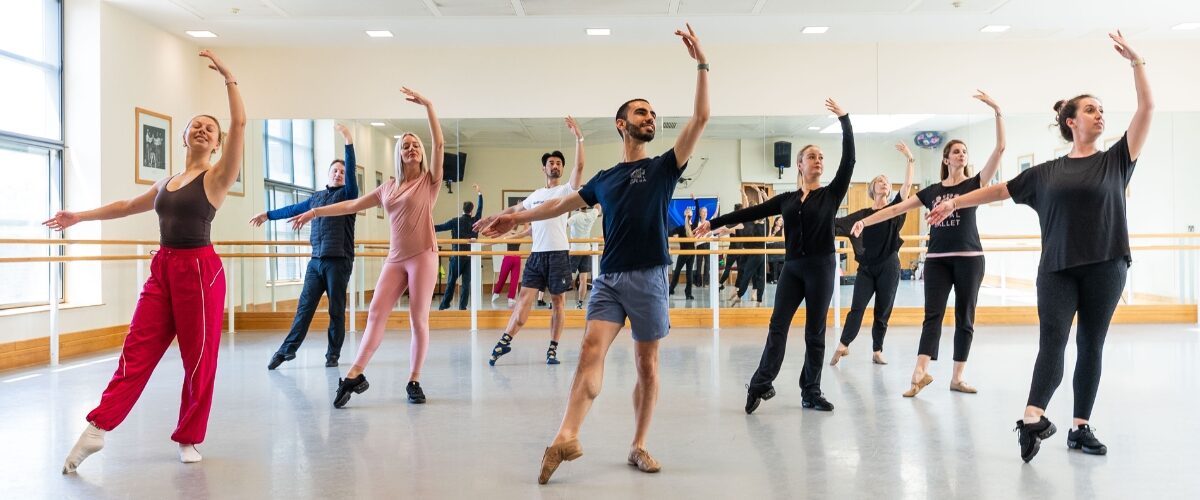
In our centenary year, The Royal Ballet School is proud to unveil the next chapter in our legacy of world-leading teacher training. For over a decade, the Diploma of Dance Teaching (DDT) has set the benchmark for excellence in classical ballet pedagogy. Now, building on that foundation, we are launching a new, reimagined teacher training pathway that reflects the needs of today’s teachers and tomorrow’s profession.
This innovative hybrid model blends the artistry, rigour and heritage of The Royal Ballet School with flexible, modern delivery making our training more accessible than ever before while maintaining the highest standards of excellence.
The DCBT programme offers two training pathways:
- Vocational teaching
- Pre-vocational/recreational teaching.
These pathways reflect the different settings in which teachers work and the types of learners they support. The training pathway offered is confirmed once you are offered a place.
Programme details
Start date: January 2027
Study mode: Hybrid (online + in‑person)
Duration: Two years part-time (with an optional exit point after Year 1)
Qualifications:
Year 1
Foundation Diploma (Level 5)
Year 2
Diploma of Classical Ballet Teaching (Level 6)
Year 3 (potential future pathway under consideration)
BA (Hons) Top‑Up
Who it’s for:
- Current or former professional dancers, with or without teaching experience
- Current teachers with 2+ years experience and Level 4 or equivalent teaching qualification seeking to develop their practice in line with The Royal Ballet School’s training philosophy.
Validated by: The Royal Ballet School (Levels 5 & 6)
Programme overview
Year 1
Foundation Diploma
The first year is an introduction to classical ballet pedagogy, technique analysis and teaching foundations for recreational and pre-vocational ballet students. Ideal for current or former professional dancers seeking a foundation in instruction and classical ballet teaching and early career teachers seeking to formalise their knowledge. Option to exit after Year 1 with a Foundation Diploma.
Level 5 | Internally validated by The Royal Ballet School
Year 2
Diploma of Classical Ballet Teaching (DCBT)
The second year focusses on developing deep pedagogical skill, dancer health knowledge, curriculum understanding and practical teaching experience. The diploma is designed for current or former professional dancers seeking an industry recognised teaching qualification, and experienced teachers seeking to formalise their knowledge in line with The Royal Ballet School’s teaching philosophy.
Level 6 | Internally validated by The Royal Ballet School
Year 3
BA (Hons) Top‑Up (potential future pathway under consideration)
A degree‑level progression route available to those entering Year 2 of the DCBT.
BA (Hons) | Externally validated by a university partner
What makes our approach unique?
- A century of excellence: our teaching programmes are shaped by 100 years of training dancers and teachers to the highest international standards, drawing from our rich heritage
- World‑class faculty: trainee teachers learn directly from experienced practitioners and artistic staff within the School, benefiting from a culture of mentorship, reflection, and continuous improvement
- Authentic teaching practice: teaching experience spread over the timeframe of study supported by expert mentors allowing meaningful opportunity to reflect, adapt and grow
- Career opportunities: our graduates are sought after internationally, including within the School, with 48% of artistic staff being graduates of the Diploma
- Research-informed and future-facing practice: in-house research, including pedagogy and healthcare, directly informs all areas of our practice ensuring innovation in action
- Ongoing opportunities for in-person and live learning: students learn through a unique blend of practical intensives, live online lectures, collegial days and observations.
Delivery model
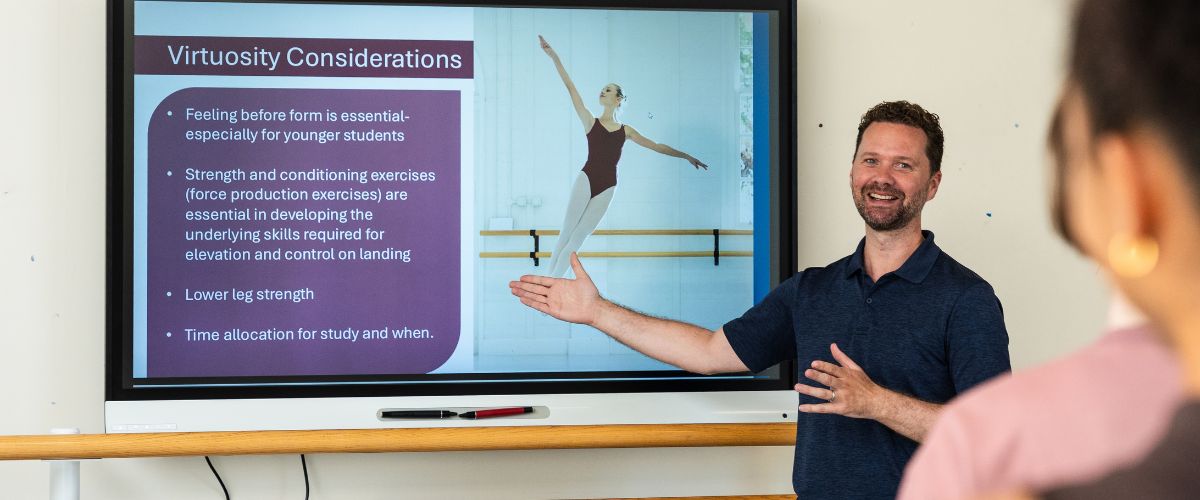
Our hybrid delivery model for dance teacher training blends online learning, in‑person intensives and teaching practice. This balanced structure offers the richness of conservatoire‑level training with the flexibility of online study, allowing our trainee teachers to develop and grow without stepping out of their working lives.
Dance teacher trainees benefit from consistent contact with expert faculty, a strong peer community and a rhythm of learning that supports deep, sustained development.
You will learn through a flexible hybrid model combining:
- Online learning: monthly live and recorded seminars and lectures
- Intensive training blocks: practical study at White Lodge, Upper School or another appropriate venue.
- Collegial days: monthly in‑person or online community learning
- Teaching practice and feedback: In your own setting and with partner schools
- Self‑directed study: reading, assignments and portfolio work.
Timeline and commitment
A part–time study programme that runs annually from January to October, with six weeks of scheduled holiday. Including guided learning, students should plan to dedicate the equivalent of two days per week to study.
Key dates for 2027:
- Applications open: 10 August 2026
- Applications close: 25 September 2026
- Programme start: January 2027
- Intensive blocks 2027:
- Spring | Five days from Tuesday 30 March – Saturday 3 April
- Summer | Three days between Wednesday 28 July – Sunday 1 August
- Autumn | Two days between Thursday 28 – Sunday 31 October (provisional)
- Location: Upper School, Covent Garden, White Lodge, Richmond Park or another appropriate venue.
Entry requirements
How to apply
There are two application options for the DCBT, either as a dancer or a teacher. Candidates applying will normally have at least one of the following:
- A minimum of two years’ professional experience as a dancer with a UK or other internationally recognised company or organisation.
- A minimum of a Level 4 teaching qualification AND
- A minimum of two years’ professional experience as a teacher.
For applications that meet the requirements for both options, please choose the option more appropriate to your personal circumstances.
The programme is delivered in English. Applicants should have a level of English that enables them to engage confidently with teaching, discussion, and written assessments.
For applicants whose first language is not English, we typically expect a level of proficiency equivalent to:
- IELTS 6.5 overall (with no component below 6.0), or
- An equivalent English language qualification.
We recognise that applicants may have developed their English skills through professional experience or training. Where formal qualifications are not available, applications may be considered on a case-by-case basis, and applicants may be invited to demonstrate their English through interview or written work.
Take the quiz below to check your eligibility and application route.
Application dates
Applications are now closed
Stage 1 results sent out: Week commencing 28 September 2026
Fees: 2027-2028
Year 1 (Foundation Diploma, Level 5) : £4,630
Year 2 (Diploma of Classical Ballet Teaching, Level 6): £4,630
(Paid termly, monthly or annually)
Application fee: £90
Registration fee*: £145
*Payable on successful application
Additional requirement: DBS check or equivalent in own country
Funding opportunities
Current or former professional dancers can access funding for retraining from Dancer’s Career Development. Check your eligibility here.
Further education pathways
After successfully completing the Diploma course, graduates from 2014 to present will be eligible for three onward routes to further their teaching education and recognition:
Diploma students will be eligible to gain Affiliate Teacher status with our Affiliate Programme through a condensed course of study, offering a mix of online and onsite training and self-study.
The Affiliate Programme is a unique, holistic and enriching approach to the training and assessment of ballet, ensuring that students can explore the art form fully through the Programme’s diverse components. It offers teachers a direct link to The Royal Ballet School, providing ongoing access to exclusive resources, advice, professional development and tutor expertise.
The ISTD will recognise the obtainment of the School’s Diploma qualification to support graduates on their teaching journey with access to ISTD Full Teaching membership.
Members gain access to a comprehensive suite of syllabi across 13 genres, alongside exclusive CPD training, teaching resources, and business support to enhance their professional practice. As part of a global network, ISTD Full Teaching members benefit from recognition through the registered member logo and are supported in building inclusive, sustainable careers through progressive training, qualifications, and events.
The School will also join the Royal Academy of Dance’s (RAD) list of dance awarding societies to offer Diploma graduates RAD Registered Teacher Status (RAD RTS).
This professional membership offers teachers a host of benefits to strengthen their reputation and employability.
Benefits of RAD RTS include the opportunity to appear on the global RAD Register of Teachers, enter students for RAD exams, enjoy the backing of a professional membership scheme, access tailored professional development, and be part of a vibrant global community of like-minded teachers.
The Royal Ballet School’s Diploma qualification enables graduates to become a Registered Teacher with bbodance. Members benefit from professional recognition and gain access to:
- Six world-class syllabi genres
- Inclusive examination pathways
- Discounted CPD
- Regional support
- Exclusive partnership deals
- Inspiring events and access to an international community
- Opportunity for students to be part of bbodance Scholars Scheme and masterclass programmes.
Frequently asked questions (FAQs)
Whether you can teach after completing the Diploma of Classical Ballet Teaching (DCBT) depends on where you want to teach, because different sectors have different requirements.
In academic schools (for example, primary or secondary education), a teaching qualification such as a PGCE and QTS is normally required. Dance specific diplomas alone are not sufficient for the teaching of dance from an academic perspective in most countries.
In the recreational dance sector (private studios, community classes, after school programmes, dance schools/colleges), there is no formal regulation in the UK or many other countries. Individual schools decide which qualifications they recognise, and our previously offered Diploma of Dance Teaching (predecessor of DCBT) was widely accepted in these settings. The Diploma also allows a pathway into teaching memberships with leading organisations worldwide.
Vocational and pre professional dance schools each set their own entry requirements, and many look for qualifications at Level 6 or equivalent. The DCBT is designed to align with Level 6 expectations in terms of depth, rigour and practical teaching competence, and it is recognised within vocational settings because it is delivered through The Royal Ballet School’s teacher training framework. Our graduates are generally well received due to their Royal Ballet School connection and the depth of training within the programme. As we progress toward higher education recognition and degree level pathways, this will open further opportunities in the future.
Intensives
The intensive weeks run on fixed dates and there is no flexibility to move them for individual applicants. If you are currently employed by a professional ballet company, it is strongly advised that you speak with your Artistic Director or rehearsal management team and request their support. In previous years, companies have usually been very willing to find a way to accommodate short periods of professional development.
If you were to miss a very small portion of an intensive due to unavoidable company commitments, we may be able to provide filmed material to ensure continuity, but this is only suitable for minor absences.
Collegial days
Collegial days take place once a month during term time at White Lodge, Upper School or another linked venue. While attendance in-person is not essential, it is strongly advised that you join as many as possible.
If you cannot attend in-person, a live online connection is required so you can participate fully and remain engaged with your cohort.
These days offer valuable opportunities for peer learning, shared practice and experiencing the School’s teaching culture first-hand. Collegial days help strengthen confidence, professional identity and overall momentum on the programme.
No, RPL is currently unavailable for this Diploma as the curriculum is specific to The Royal Ballet School’s System of Training. We are exploring an RPL framework for alumni of our in-house teacher training programmes for future intakes.
For professional and ex-professional dancers in the UK, you may be eligible for a retraining grant from Dancer’s Career Development (DCD). You can check your eligibility here.
While government funding is not available for this Diploma at present, this may change in the future. Should we introduce a BA (Hons) Top-Up pathway, we will provide updates to reflect any new funding options and course updates.
Yes, you can submit your application via the teacher application route.
We recognise that not all teachers have had access to a conventional training pathway, and we aim to be as equitable as possible in how we assess applicants. Some teachers bring strong studio experience, vocational backgrounds or clear teaching potential that may not be reflected in formal qualifications.
Consideration will be given to your whole profile in order to determine whether your experience prepares you for the level and depth of study required on the Diploma, even if you do not meet every listed requirement.
Yes, the course is for both pre-vocational and vocational ballet teachers. Many of our Diploma graduates teach for or own their own recreational dance studios and work with mixed ability groups.
The programme focuses on classical ballet pedagogy, safe and effective teaching practice and developing a strong technical eye – all of which are essential whether you teach recreational students, aspiring dancers, or those already in vocational training.
Passing Level 5 does not automatically guarantee progression to Level 6. To progress from the Foundation Diploma (Level 5) to Year 2 of the DCBT (Level 6), students must:
- Obtain a successful Level 5 pass in all practical modules
- Demonstrate secure technical understanding and safe demonstration of Level 6 vocabulary
- Show readiness for advanced study through reflective and professional behaviours.
Progression decisions consider the whole profile – technical ability, demonstration quality, pedagogical understanding, reflective engagement, and consistency across the year.
Students who complete all Level 5 modules but do not meet the Level 6 progression threshold may exit with the Foundation Diploma. Students may also re apply for Year 2 in a future cycle via the teacher application route.
The course has helped me take my teaching practice to the next level. I feel more confident in helping students of all ages achieve their dream in a way that builds them up and prepares them for the future, whatever they chose to do. – Nic, current DDT student
The diploma offered me a fresh and exciting approach to classical ballet training. It inspired me to re-evaluate the way I teach entirely and gave me the confidence to not only challenge myself, but also celebrate my unique strengths as a teacher. – Holly, DDT graduate and Associate Teacher
The placements gave me the opportunity to put theory into practice. Being exposed to a vocational ballet school alongside very experienced teachers has been priceless and highly beneficial to my teaching practice. – Paula, DDT graduate
Any questions?
If you have any questions, please get in touch at [email protected].
Register your interest
Register your interest below to be the first to hear news and updates.