
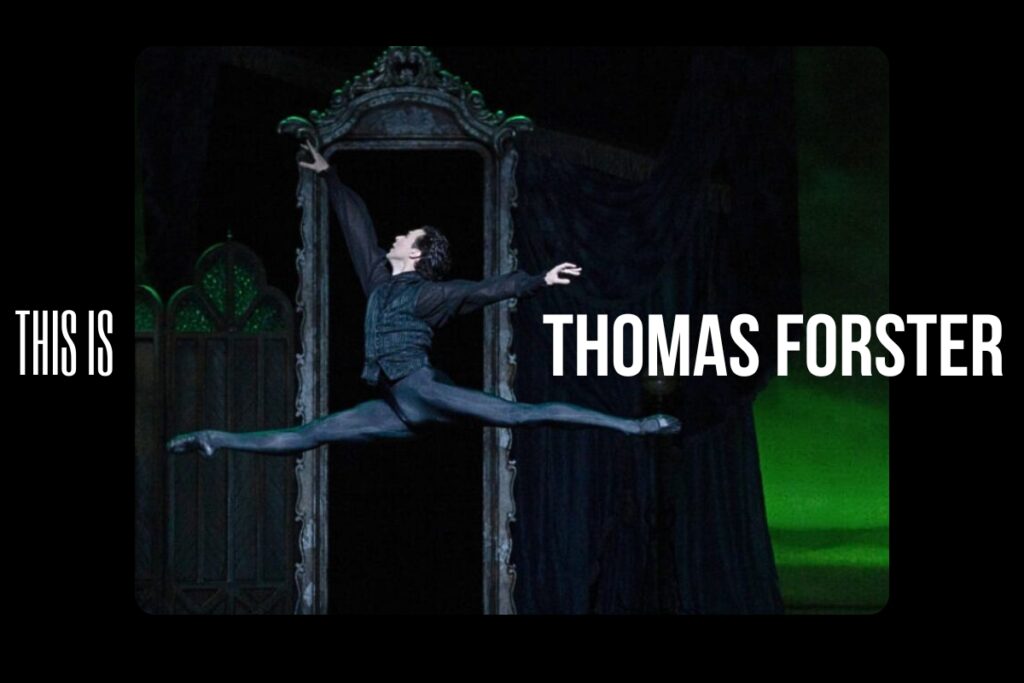
100 stories: Thomas Forster MBE
As part of our centenary year, we are featuring 100 stories that make up The Royal Ballet School’s past, present and future. Today, we share the story of alum, Thomas Forster MBE.
Thomas is a Principal dancer at American Ballet Theatre. He joined The Royal Ballet School first as a Junior Associate then as an Upper School student in 2002. He graduated into American Ballet Theatre Studio Company, where his career in the United States blossomed. Thomas shared insights into his time at the School and career highlights with us:
When did you begin dancing and what was your route to train at the School?
I grew up in South East London, and I loved football, but my mum made me do ballet as well. The ballet teacher said I had a good facility for ballet, and she recommended The Royal Ballet School’s Junior Associate Programme. I started the Programme when I was eight, and I had Ms Hubbard as a teacher – she was incredible. That’s when I started to love ballet because I was finally amongst boys my age doing ballet together. Those classes were more tailored towards young boys; there was camaraderie and competition, and ballet became fun. Some of the boys I met in that class are still my mates; we speak every day.
I went to the Summer Intensive which was fun, so I then auditioned for White Lodge. They didn’t accept me, and that was tough. Ms. Hubbard advised me to audition for Elmhurst Ballet School because it was more of a performing arts school back then. I was there for five years, and they thought I was more suited to ballet rather than jazz and modern. After that, I joined The Royal Ballet School’s Upper School.
At the beginning, going to these schools was a way of getting a better education. I received funding to attend both schools. As I moved through my education, I fell in love with ballet.
What are some of your favourite memories from your time at the School?
Honestly, I just loved it. It was the best three years. The training was incredible. Each year, the School progressed me. I came in getting commendations for assessments, and I left getting honours. The training I received got me to where I am today. Then there are the lifelong bonds I made and the fun we had outside the studio at that age.
What memories do you have of the performances?
I was always an anxious performer. I remember performing at the Opera House and in the Linden Studio at the School – I was highly nervous and probably a hot mess! It was always rewarding though, and I felt nurtured by the teachers.
How did you get over those nerves?
I grew up, and I realised that no one cares. It’s internal and ego. When other people mess up, I don’t care. When I mess up, it felt somehow different, but I realised it’s not. All that stress and anxiety is a waste of energy. I was lucky enough to become a father, and that put life into perspective. I want to do well in my career because I’m providing for him, but at the same time, as soon as I’m with him, I forget about all those things.
What did you learn at the School that you use in your professional life?
Hard work and consistency. The teachers were incredible. I had David Peden, Christopher Powney and Gary Norman. All of them brought out something different in me. Mr Peden was focused on structure and technique. Mr Powney focused on building confidence and taught me to go for it. Mr Norman’s style was a bit freer; his classes prepared us for company life because the steps were difficult to execute. I was constantly trained to be respectful, tidy and on time. I see it with other students who graduate from the School – they have a work ethic and understanding.
Do you feel a connection with those other graduates?
There’s a connection with anyone who’s experienced training at the School. It sounds weird to say out loud, but it’s a badge of honour. I’m proud to be a Royal Ballet School alum. I look out for Royal Ballet School graduates coming through. The standard of the young dancers coming up keeps getting higher and higher. They need no mentoring from me; they’re amazing and teach me what to do.
Who did you look up to when you were at the School?
I was never a ballet bunhead, so when I got to the School and saw Carlos Acosta for the first time, I was blown away. My year was also incredibly talented. I was dancing with Liam Scarlett, Xander Parish, Joseph Caley, Shevelle Dynott, James Forbat, Alexander Jones, William Moore and Aaron Robison. I’m forgetting names, but the list of principal dancers from that year was insane. I admired my classmates more than anyone.
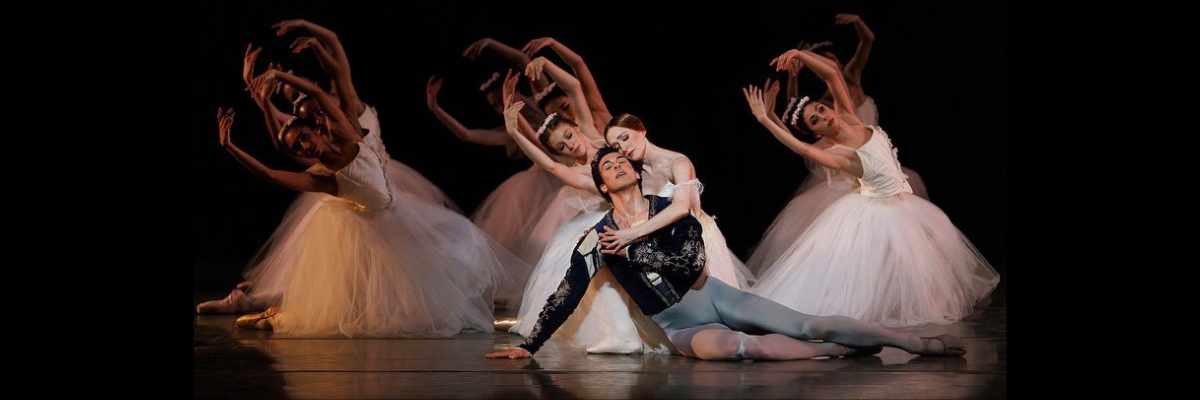
Thomas Forster and Gillian Murphy in Giselle with American Ballet Theatre (photo by Ben McKeown)
Do you remember when you received the offer to dance with American Ballet Theatre?
I was in my final year at the School, and we had an exchange programme with American Ballet Theatre. One of the chorographers we worked with recommended me to the Director of ABT Studio Company. When we performed in New York, after the show, they offered me a contract. I was offered a contract with Birmingham Royal Ballet, too. My Dad said ‘Mate, you’ve got the choice between living in Birmingham or New York, I think it’s pretty obvious which you have to choose.’ It’s interesting though because loads of my mates are in Birmingham, and it’s not far from my family in London. So even though I have a wonderful career, a beautiful son and I’m very happy, sometimes I think, if I had the decision again, would I make the same choice? Being close to home would be great, but when you’re 18 or 19, you don’t think about that.
When you began dancing with ABT, did you have to adapt to an American style of ballet?
The style is technically the same, but the attitude is different. In England, there was a focus on everything being correctly placed, using control and taking a calm approach. In America, it was like, just go for it! I think both have their merits. Too much control can be a snooze fest, and you can watch someone without the greatest technique go for it and still be impressed. I appreciated coming to America for this reason, but I think in a school setting, you need to learn control and calm.
What have been some of your highlights in the Company?
I’ve had such a crazy career really. I was in the corps for a very long time and then became Soloist. Leading up to the pandemic, I started to get huge opportunities, but I was getting older. The company gave me a promotion, which I was shocked by but so grateful for. It’s nice to experience the major ballets at the tail-end of my career as a Principal. When I leave, I’ll have a good understanding of what each level requires and the highs and lows of being at each level. Recently I got to play Eugene Onegin, a lifelong dream role, and it went really well. I was so happy. I can’t believe this is my job sometimes.
Which choreographers have you enjoyed working with?
We had Wayne McGregor out here doing Woolf Works. Firstly, I love that piece, but to have so many British people in the house was great! They went back to the UK for a couple weeks and I gave them a shopping list of Polos and Lion bars which they brought back for me. We also had Christopher Wheeldon come to set Like Water for Chocolate. It’s always lovely to meet choreographers and répétiteurs, but selfishly, I love when anyone from the UK visits.
What changes would you like to see in dance training and companies?
I think in ballet training, there’s already been a move to a more scientific approach to building strength which would be great to see continue. I think there could be more support for our mental health because whether you’re young or old and have performance anxiety or other stresses that come with this career, it can only be helpful to have support there. It’s important to have someone to talk to.
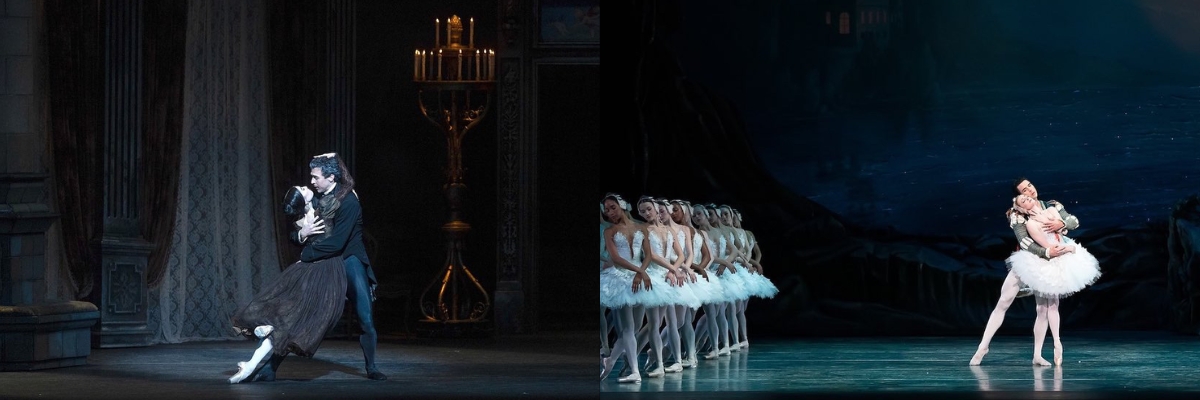
Left: Thomas as Eugene Onegin (photo by Rosalie O’Connor); right: Thomas in Swan Lake (photo by Kyle Froman)