
Alum Louise Flanagan on designing the costumes for Cathy Marston’s A Line in Reflection
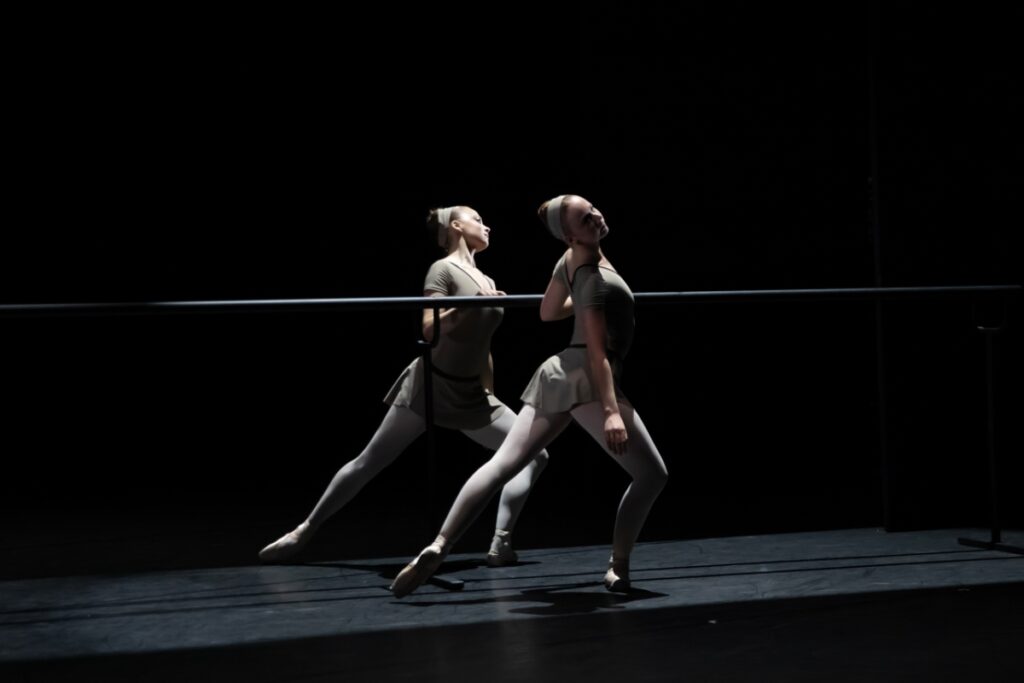
We were thrilled to welcome alum Louise Flanagan back to the School this year to design the costumes for fellow alum Cathy Marston’s new work, A Line in Reflection, created especially for our Centenary Summer Performances. Louise drew from her experience as a student to thoughtfully design the costumes, worn by our 2nd Year students.
Louise attended all three years at Upper School and was one of the first students to train in the new Floral Street studios, which opened in January 2003. ‘It was really exciting to be in this new building right next to the Royal Opera House, to have access via the Bridge of Aspiration and watch all The Royal Ballet company dancers in class, rehearsals and performances. Now, in my costume work, I’m coming back into contact with so many of these people that I was at the School with who are now also in different roles – choreographers, designers or moving towards directorship positions. We all have this shared history of the training and time at the School. Some of them are still my closest friends 20 years later even though we all live across the world.’
Following her graduation, Louise danced at the Vanemuine Theatre in Estonia until 2008, when she became interested in costume design and production. She earned a BA (Hons) first-class in Dance and Performance Costumes from Middlesex University and completed a professional dressmaking apprenticeship at Berufsschule für Bekleidung in Munich, Germany. She has been a costume designer for ballet and opera since 2013, working with fellow alumni Cathy, Andrew McNicol, Dustin Klein and Peter Leung.
Collaborating with Cathy
Before Cathy took the helm at Ballett Zürich, Louise was working at the company on re-staging Cathy’s The Cellist. ‘I was working with Cathy’s designer, Bregje van Balen, so that’s how I met her. During the pandemic, I did a research project into more sustainable fabrics that can be used for dance and theatre productions. Cathy was putting together a programme for the junior company in collaboration with University of Zürich, tackling the themes of climate change and sustainability. It was looking at climate change and asking ‘Does dance have a role in it? How can we work in a different way?’ She invited me to design for her and two other choreographers on this programme, and it was amazing to be back in Zürich in the role of a designer, not assistant.’
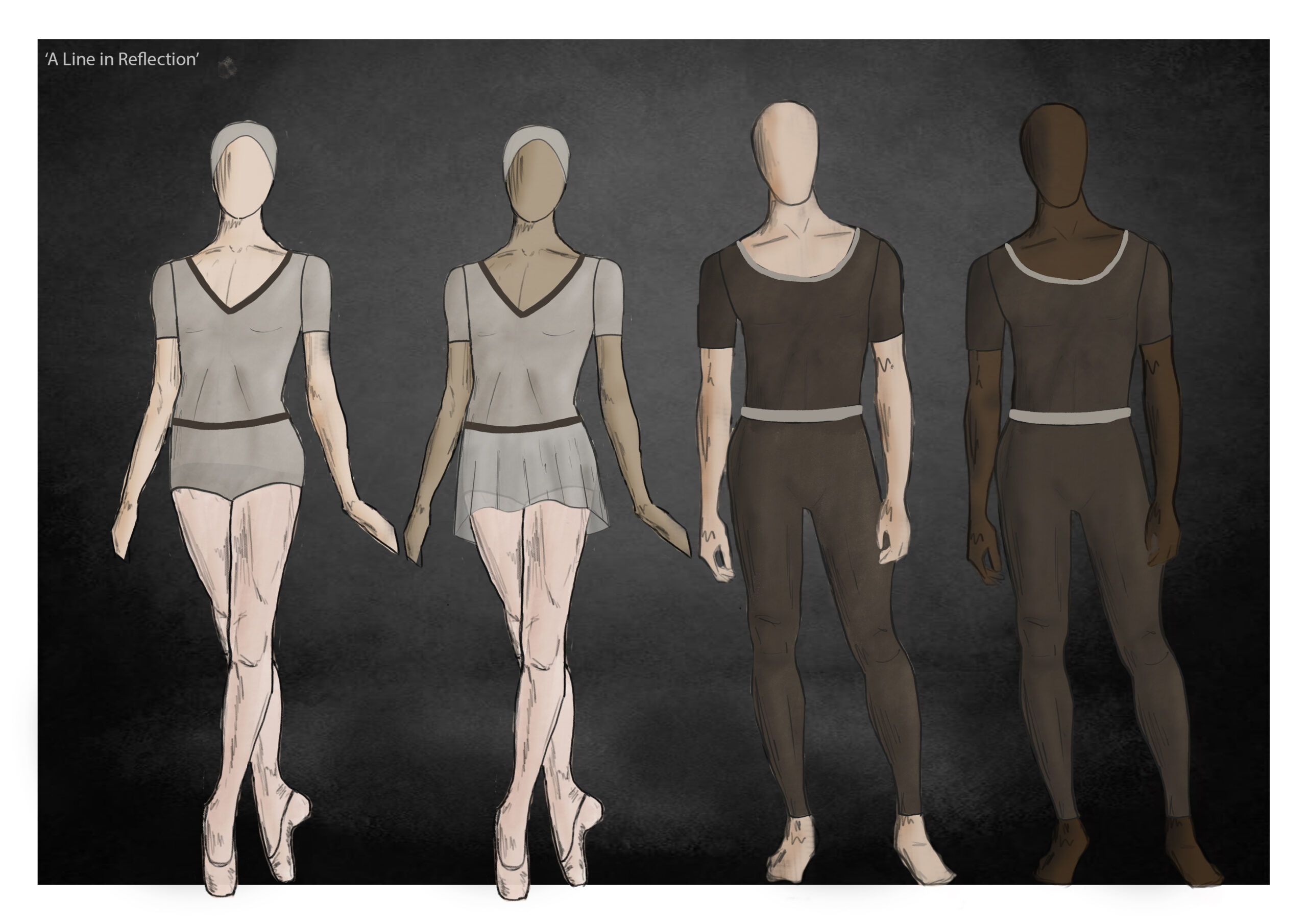
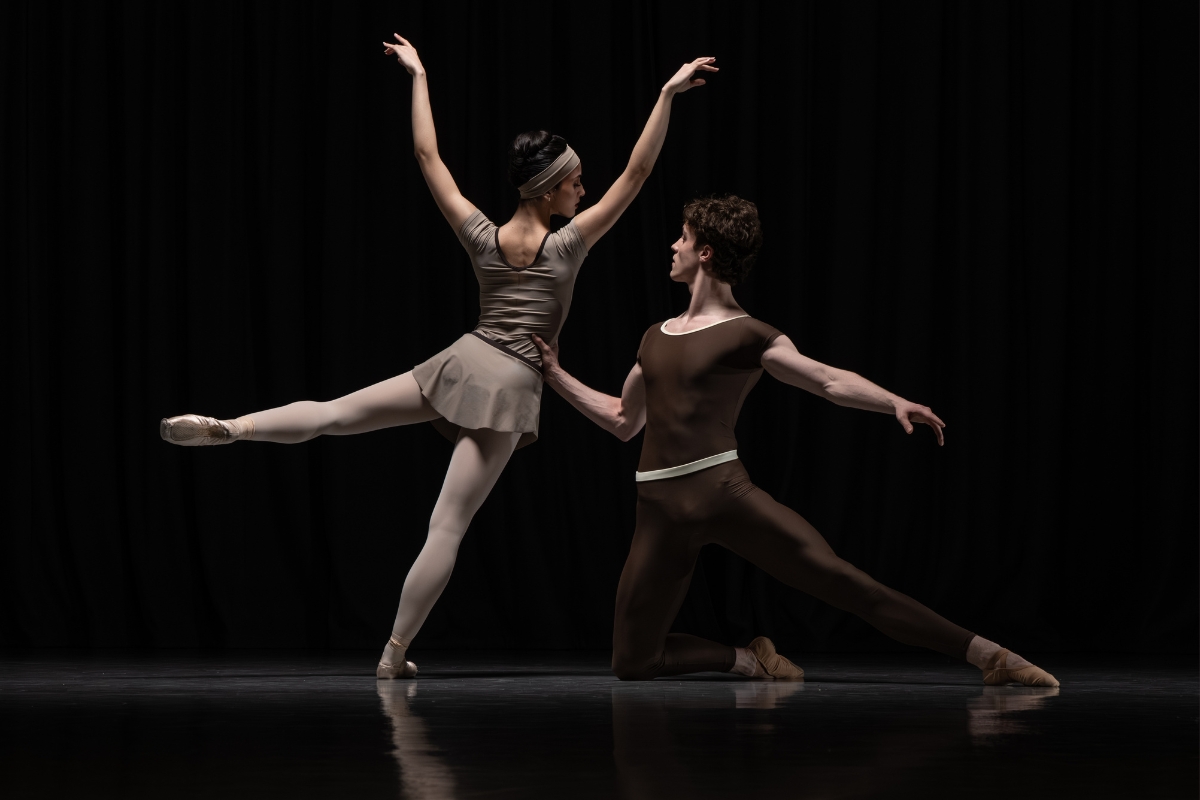
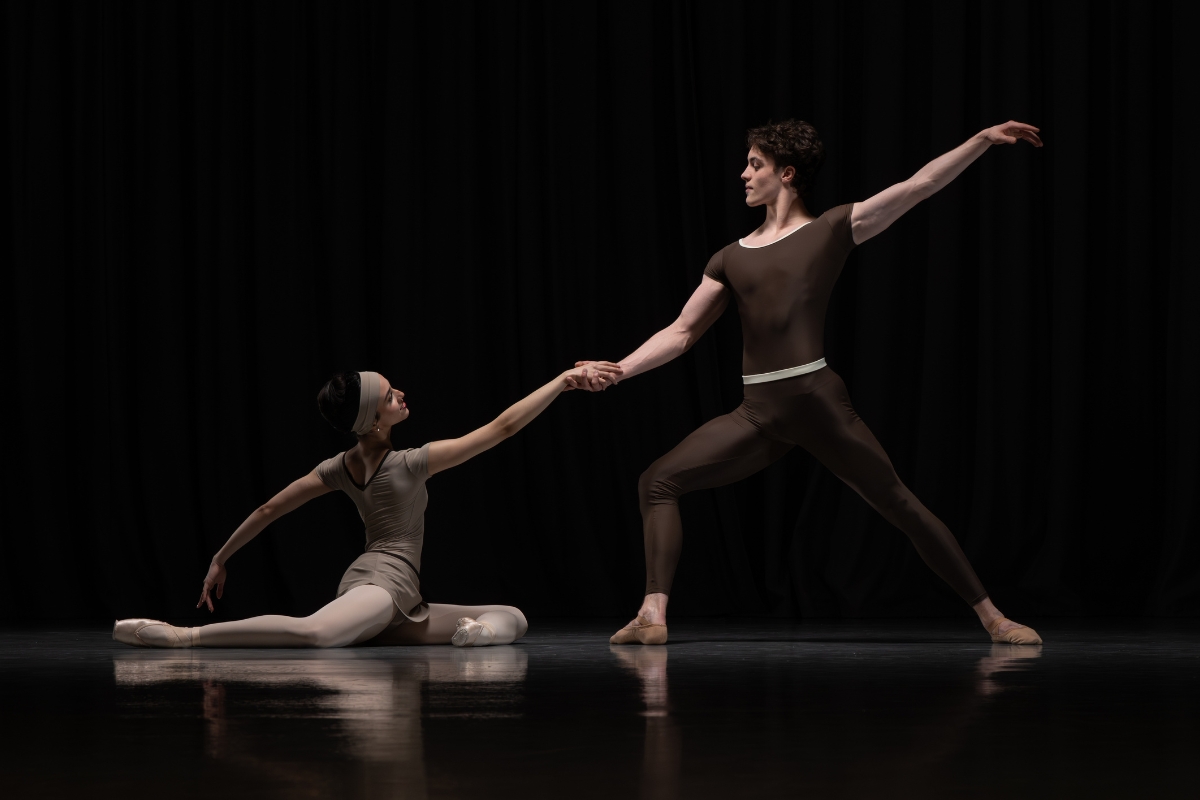
When Cathy began choreographing A Line in Reflection in 2025, she asked Louise if she, as a fellow alum, would like to design the costumes. ‘I had the rehearsal video material, and we talked a lot about her ideas with Baroness Deborah Bull being in the piece, of this feeling of looking back and looking forward. We had the idea of school uniforms, but I’ve given everything a sepia colour tone, as though you’re looking into the past through a lens. I looked back at different uniforms from the School over the past 50 years and noted details, like the belts and the headbands, just to give it sort of an old-fashioned look.
I work with a mix of drawing and Photoshop collaging. I like to create quite realistic sketches of what I imagine the costumes would look like. I need to know how I think it’s going to look in the final version so that the choreographer also has a realistic image to imagine the costume movement with their choreography.
I sourced different fabric samples to find the colours that we wanted and that were a good quality of Lycra, then we organised making the prototypes. It was really lovely to work with the School’s Performance Costume Supervisor Lauren Venus. I had an online fitting with her and two of the students.
It’s a process of elimination, taking away things, focusing more on the things that seem to be going in the right direction until it sort of hones in on what feels right. Costumes should enhance the movement, not distract from it. Cathy’s great to work with because she knows quite quickly if she likes something or if she doesn’t. And if she doesn’t like something, she’s also able to articulate why.’
Reflecting on student life
Returning to the School brought back many memories, both happy and bittersweet, for Louise.
‘The first time I came back into the School was strange. I think I was surprised at how many new offices there are everywhere. It felt familiar but also unfamiliar. I can tell a lot has changed in regards to the health, safety and wellbeing of the dancers, which wasn’t so present 20 years ago.
It was lovely to come back and see the students performing on stage. There were moments where I had flashbacks and I thought I saw some of my friends from school dancing on stage.
I think that when I was a student, I would have really appreciated seeing people who had been through the School and had a dance career but then pursued something else, either within the arts world or beyond.
It’s not the end of the world if you’re not a dancer for your whole career. It’s an amazing career to have and The Royal Ballet School gives you great opportunities that can actually take you anywhere, not just within the dance world.’
Introduction to costume design at the School
Although current students have the opportunity to design their own costumes through the Ninette de Valois Choreographic Programme, Louise had a slightly different path to the industry. ‘When I attended the School, we had a BTEC in arts management where we got to go around to all the different departments in the Royal Opera House. I remember finding that amazing, to be able to see the sets and costumes backstage, even the press office and the amount of people working backstage behind a production.’
While dancing in Estonia, Louise became more inspired by the ‘cogs turning behind the scenes’ to produce a show. ‘It was a really eye-opening experience to be in a theatre where they had all the workshops on-site and we’d go for costume fittings in the costume workshop. You could see everything for a premiere happening in parallel to us in the studio. That really opened my eyes to the many skilled departments working on a production.
Ever since I was a child, I’d always had a sewing machine. I bought myself one whilst living in Estonia where the winters were so cold that I spent a lot of time just making things for myself. From there, I started doing small projects with friends who were choreographing.
When I decided to stop dancing, the qualifications I had from the School enabled me to enrol on a course at Middlesex University and complete a bachelor degree tailored to specific interests within the area of dance and performance. I tailored mine to costumes for performances, researching the history of costuming and interviewing dancers about how costumes can affect their performances – how they feel, how they move, what affects they have on their performance or role.’
Transitioning from dance to design
Louise’s transition away from dancing felt like a natural progression, but there were aspects of performance that she missed. ‘I was quite sure that it wasn’t the right fit for me to be on stage. I felt like I had to work so hard to sustain a good enough level for what I felt was necessary as a ballet dancer. I still loved it. I just knew that it wasn’t the healthiest or right thing for me to do.
I missed the feeling of being thrown together with people in these often very stressful situations. There are blood, sweat and tears every day, so the friendships and bonds that you form are very strong. It takes a long time when you’re not in that environment to create those friendships and connections with other colleagues or even new friends.
Ballet class is so structured, and rehearsal schedules are set out for you. When you transition out of dance, you can feel a little lost at first and outside of your comfort zone. But you begin to realise the skills you have are transferable to other things. From such a young age, you learn to collaborate and work with a group of people with different backgrounds, nationalities and languages. It’s a really useful skill that I see a lot of my friends who’ve stopped ballet have too.
It’s called The Royal Ballet School for a reason; it’s training the ballet dancers of the future. But I really enjoyed the academic subjects too and the opportunity to do Maths A level. It was a rest for my body, and a chance to use a different part of my brain. Moving to the School at such a young age definitely teaches you this incredible independence and resilience. I’m really happy that those experiences have kept me in the dance world and taught me so much, but I now use them in a different way than I thought I would when I was at the School.’
For young students and dancers considering a career in costume design, Louise says, ‘Go and watch as many performances as you can. Just wander the corridors backstage when the dressers are setting up the costumes for performances. Working in a theatre, you have so many different skills all under one roof. Shoemakers, wigmakers, set designers and builders, lighting designers, lighting technicians, all the backstage staff, etc. If you ever have the opportunity to go into the workshops, just have a look around, keep your eyes open and ask questions. Everybody in the workshops are really friendly, and they love the engagement with the dancers. If you have opportunities at the School to design costumes for choreographic competitions or showcases, just try!’
Catja Christensen is the Marketing and Communications Executive at The Royal Ballet School and joined the School in 2025. She enjoys interviewing students, staff and guest artists for news stories and crafting eye-catching newsletters.