
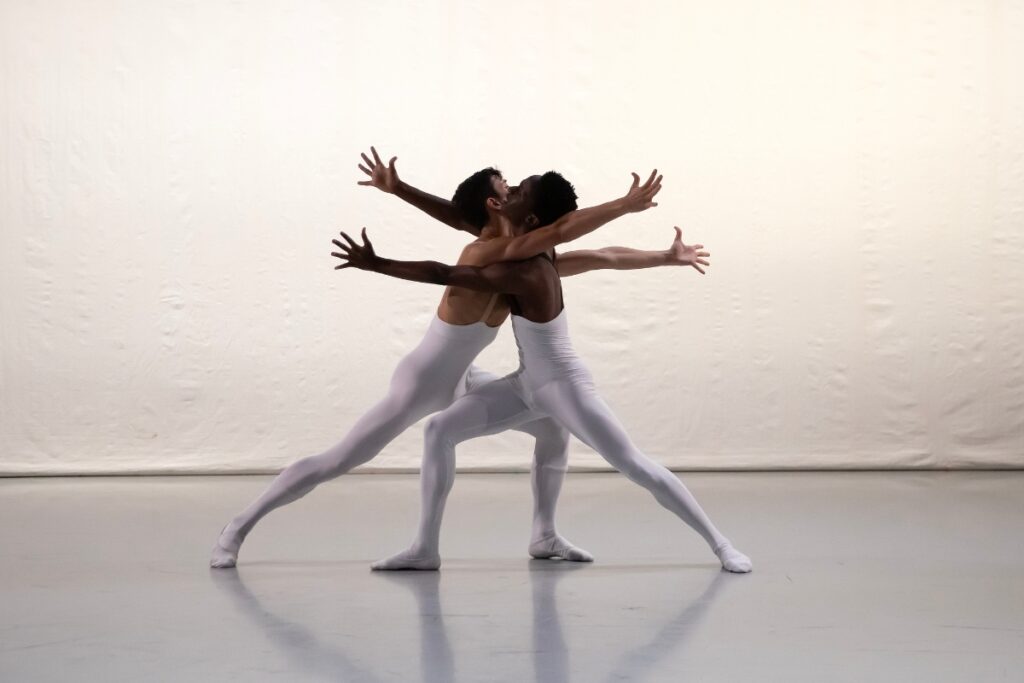
Frederick Ashton Emerging Choreographer 2026
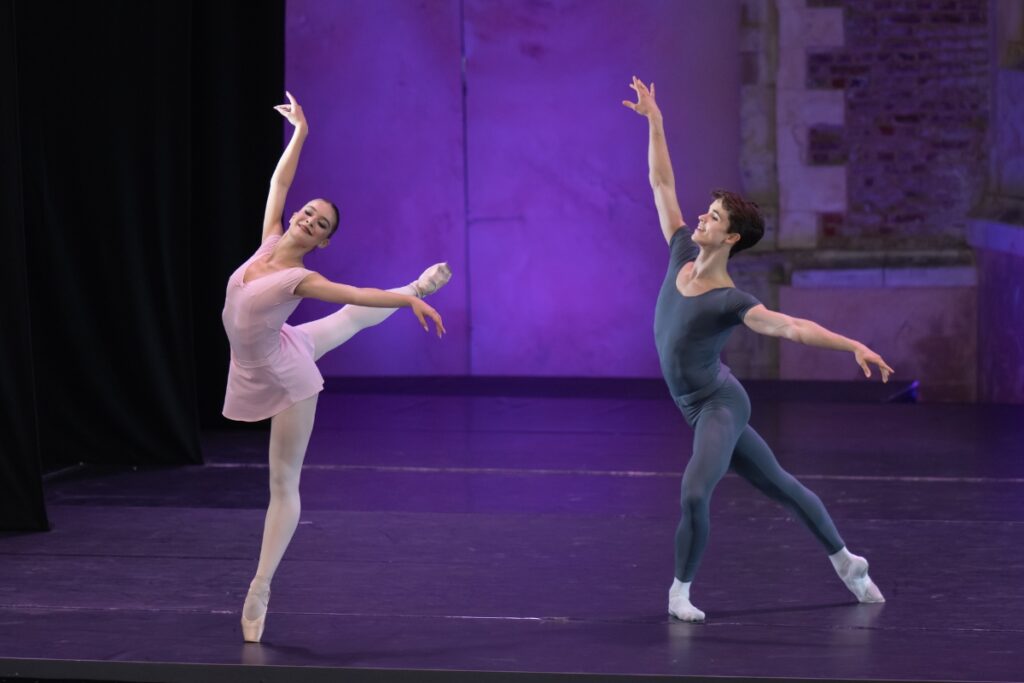
On Wednesday 6 and Thursday 7 May, our 2nd Year students participated in the annual Frederick Ashton Emerging Choreographer performances, held at the Upper School Linden Studio Theatre.
Named for the Founding Choreographer of The Royal Ballet, Frederick Ashton, this event invites students to develop and present their own choreography under the guidance of Choreographic Course Coordinator & Tutor Mikaela Polley. The 15 student choreographers also worked with Production and Theatre Technician Daniel Philipson and Wardrobe Supervisor Anja Mlakar on lighting and costume design to bring their work to life.
This marks the final event of the year in the Ninette de Valois Choreographic Programme. The Programme is an integral component of our students’ academic and artistic education, providing a platform for our emerging artists to create and explore and allowing them to develop their expressive instincts alongside their technical training.
Special guests Stina Quagebeur, English National Ballet Associate Choreographer, and Marcelino Sambé, Principal with The Royal Ballet, joined as panellists and provided individual feedback to the young choreographers.
Multicultural fusions

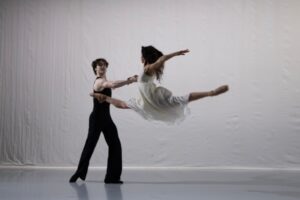
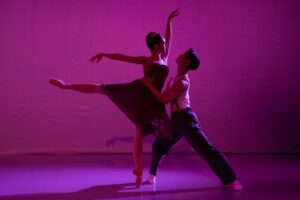
An overarching theme across several choreographies was incorporating influences from a range of cultures. Minjun and Juliet turned to family histories for creative stimulus. Minjun’s Still Speaking, performed by Emiliano and set to Camille Saint-Saëns’ The Swan, incorporated American sign language and poetry and drew inspiration from Emiliano’s mother, who works as a language therapist. Juliet’s Umbra is a love letter to her grandfather and Western cinema.
Emiliano’s Danzón blended classical ballet with the Cuban national dance, which is also popular in his home country. ‘I grew up watching and admiring danzón, and it inspired me to create this piece where I merge both of my worlds together through my own movement language,’ he said.
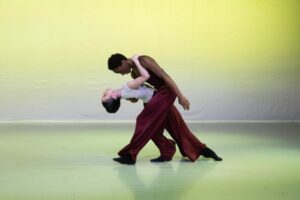
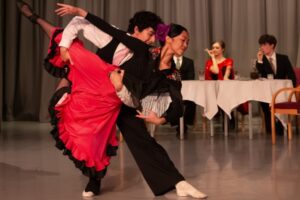
Spanish student Cesar and Indonesian student Krysante also incorporated elements of their home cultures in their works. Cesar presented Un Café Literario, based on the intellectual movement in Madrid in the early 20th century. He learned the Escuela Bolera dance style and integrated it into a classical ballet foundation. Victoria, a student from fellow Music and Dance Scheme institution The Purcell School for Young Musicians, provided live accompaniment. Krysante’s title, Swarasa, combined two Indonesian words: ‘suara’ (voice) and ‘rasa’ (feeling), meaning ‘the voice of emotion in the heart.’ Her dancers appeared in couples as a series of romance-filled vignettes.
The power of love
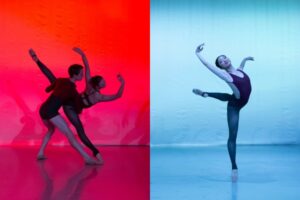
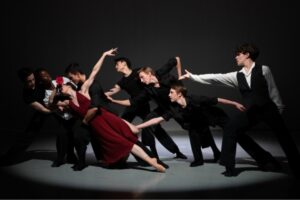
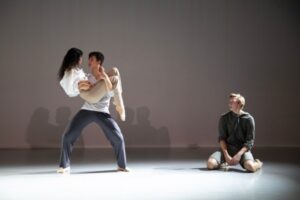
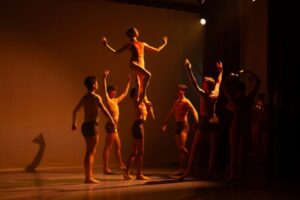
Relationships and love were also prevalent themes throughout the afternoon. Yasmim’s Philautia centred self-love. She described her work as ‘an exploration of love not as a romantic ideal but as an existential processs of self-recognition and acceptance.’ Conversely, Léo explored the desire for external sources of love with Medusa Effect, a high-energy work demonstrating the loss of power and vulnerability in relationships. Clovis explored romantic relationship dynamics in Tangle, a tension-filled love triangle juxtaposed with fluid partnering and warm lighting that shifted to a stark cold light when conflict rose.
Jorge focused his work on a less tangible form of relationship: life and death. What Remains was an atmospheric, evocative imagination of human existence. He said, ‘A vision is proposed where existence does not end but disappears.’ Small lights attached to the dancers’ fingers illuminated the foggy stage like fireflies, symbolising life and energy between entities.
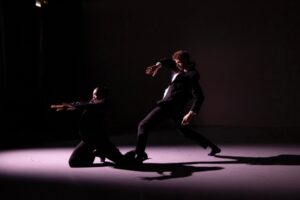
One final relationship emerged from the group: political power plays. Set to a recording of Richard Nixon’s address to the nation in 1973, ending the Vietnam war, Soren’s Peace with Honour featured Krysante and Luca dancing in a tumultuous, aggressive duet. Dressed as politicians in boxy suits and ties, the piece ended with flashing strobe lights as they shook hands, emulating the performance of politics in the press.
Strength and resilience
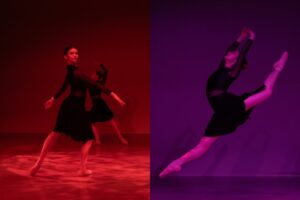
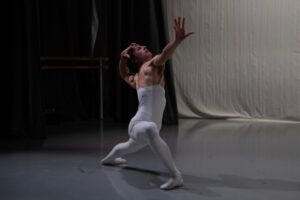
Overcoming adversity and finding inner strength emerged among Yuzu, Harry and Lilly’s works. Yuzu’s cast embodied the School’s motto, ‘strength and grace,’ by using a rose as a metaphor for how beauty, strength and protection can work together. ‘I was inspired by women’s ability to keep moving forward even after facing challenges, pressure or judgement from others,’ Yuzu shared about The Rose.
Harry’s work was inspired by a conversation he had with Foundation and Development Programme ballet teacher Nicola Katrak about showing lived experiences on stage. His piece, The Bravery to Stand Again, was both deeply human and angelic, minimalist yet expansive, a tribute to ‘all the people who have had the bravery to fail and stand up again,’ Harry said.
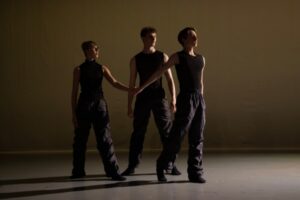
While Harry’s piece explored the aftermath of recovering from failure, Lilly’s On the Edge of a Great Precipice explored how crippling the fear of failure can be. Her elastic, tension-filled choreography was rooted in the anxiety and apprehension of fearing failure before it happens.
Conceptual experimentation
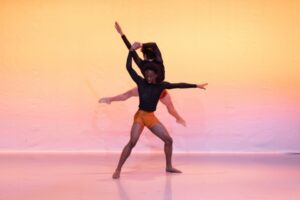
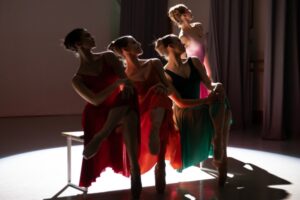
Finally, Archie and Maria’s choreographies were creative experiments based on their stimuli. Archie’s non-narrative Glassworks centred on Philip Glass’s Rubric score with reactive, playful movement. Archie also explored the dynamics between two male dancers, Sasha and Keenan, and the new partnering opportunities offered.
Maria’s Dancing Fool closed the programme with musical theatre energy and character. She said, ‘Over the years, I’ve always felt more drawn to creating pieces with a more intense and melancholic charge. This time, I wanted to step out of that comfort zone and try something light, vibrant and full of joy.’ The ladies were dressed in a rainbow of colours with the men in all black. Fedoras, backflips and even a jilted proposal punctuated the infectious joy on stage.
Congratulations to all students for their effort in producing a spectacular performance, and thank you to the staff and supporters for continuing to provide these emerging choreographers.
Catja Christensen is the Marketing and Communications Executive at The Royal Ballet School and joined the School in 2025. She enjoys interviewing students, staff and guest artists for news stories and crafting eye-catching newsletters.